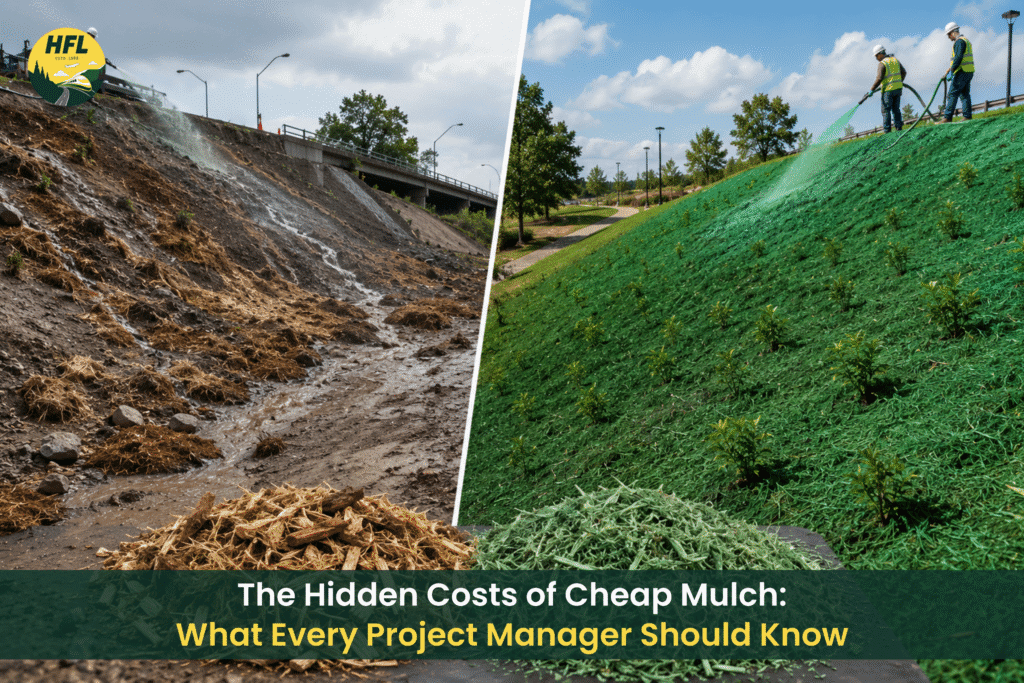
When project budgets are tight, choosing the cheapest material can appear to be a practical way to manage costs. In theory, the cheaper mulch sounds like an immediate savings, especially on large hydroseeding, revegetation, landscaping or erosion-control projects.
But the cheapest purchase price is not always the cheapest project cost.
The real comparison between cheap mulch vs quality mulch goes beyond the initial quotation. Project managers must consider application performance, coverage, moisture retention, erosion protection, labour requirements, reapplication, vegetation establishment and the risk of project delays or corrective work.
A material that may save money at the procurement stage can become expensive if it requires a higher application rate, performs inconsistently, washes away during rainfall or contributes to poor vegetation establishment .
This raises an important question for project managers, contractors, landscape professionals and infrastructure teams:
Are you buying the cheapest mulch—or choosing the mulch that delivers the best value over the entire project lifecycle?
At Haryana Forests Ltd, the focus is on helping projects consider mulch as a performance-critical input rather than simply a line item on a purchase order. Material selection should match site conditions, application requirements, project specifications and expected performance.
This guide explores the hidden costs associated with choosing mulch primarily on price and explains what project managers should evaluate before making a procurement decision.
Why the Cheapest Mulch May Not Be the Most Economical Choice
Procurement decisions often begin with a simple comparison: price per bag, bale, kilogram or tonne.
That number matters—but it does not tell the entire story.
Two mulch products with different prices may also differ in composition, consistency, water-holding characteristics, application behaviour, coverage and suitability for specific site conditions.
Purchase Price Is Only One Part of Total Project Cost
A project manager should consider the complete cost of using a product.
That may include:
- Material purchase
- Transportation
- Storage and handling
- Equipment time
- Labour
- Application rate
- Reapplication
- Site remediation
- Schedule delays
- Maintenance requirements
Suppose Product A is cheaper per unit but requires more material to achieve the desired application or needs repeated work after poor performance.Product B may cost more initially but provide more reliable performance under the required project conditions.In that situation, Product A may no longer be the economical option.The correct comparison is therefore not simply:
“Which mulch costs less?”
It is: “Which mulch provides the required performance at the best total project cost?”
1. Low Quality Mulch Problems Can Lead to Rework
Rework is one of the hidden costs that is easiest to underestimate.
If an application does not go as planned the contractor may be required to go back on site, re-prepare areas, change out material and repeat some of the original work.
One Failed Application Can Affect Multiple Cost Centres
Potential consequences may include:
- Additional mulch
- Extra seed or amendments
- More labour hours
- Equipment remobilization
- Fuel expenses
- Site access costs
- Extended supervision
- Schedule disruption
These expenses can quickly reduce or eliminate the savings achieved by buying a cheaper material.
Rework can be particularly challenging on large or remote sites where mobilizing equipment and crews is expensive.
Project managers should therefore evaluate the risk-adjusted cost of material selection, not only the initial invoice.
2. Inconsistent Material Can Affect Application Performance
Consistency is key in mechanised applications such as hydroseeding.
The behaviour of the material can change from batch to batch because of differences in particle characteristics, composition or processing.
Consistency Supports Better Project Control
Reliable materials help contractors plan application more accurately.
Depending on the mulch type and equipment being used, poor consistency may contribute to operational challenges such as:
- Difficult mixing
- Uneven slurry behaviour
- Application inconsistencies
- Equipment inefficiency
- Variable coverage
This matters because every interruption costs time.
If operators must repeatedly adjust the mixture, stop equipment, troubleshoot problems or compensate for inconsistent material, labour and machine hours increase.
For large projects, even small inefficiencies can become significant when multiplied across many hectares.
3. Hydroseeding Mulch Quality Can Influence Establishment Conditions
Hydroseeding combines selected materials—often including seed, mulch, water and other specified components—to support vegetation establishment.
Mulch plays an important functional role within that system.
Mulch Is More Than a Carrier for Seed
Depending on the product and application, mulch may help:
- Support moisture retention near the soil surface
- Provide temporary surface protection
- Create a more favourable microenvironment for germination
- Support more uniform application
- Reduce exposure of seed and soil to environmental stresses
This is why hydroseeding mulch quality should be evaluated according to the actual needs of the project.
Mulch cannot compensate for poor seed selection, inadequate soil preparation, incorrect application, unsuitable weather or lack of necessary aftercare.
However, selecting an unsuitable material can make an already challenging site more difficult to establish successfully.
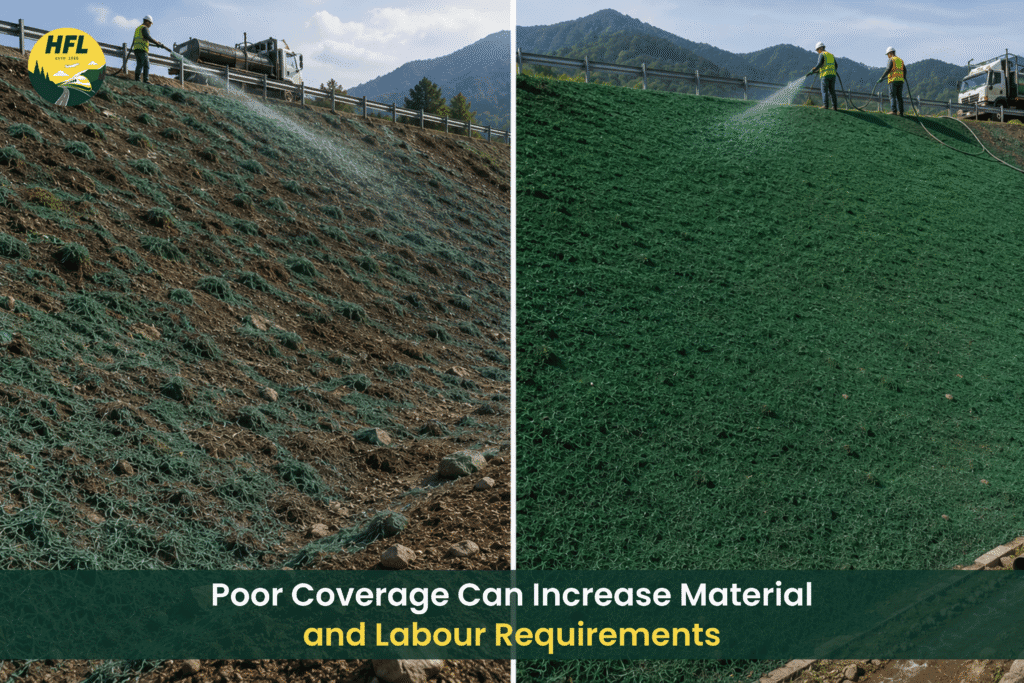
4. Poor Coverage Can Increase Material and Labour Requirements
A low unit price can be misleading when coverage and required application rates are ignored.
Project managers should compare products based on how much material is actually required to meet project specifications.
Calculate Cost Per Treated Area, Not Just Cost Per Unit
A more useful calculation may include:
Material cost + transport + labour + equipment time ÷ successfully treated area
This provides a more realistic view of project economics.
If a cheaper material means significantly more product or passes to achieve the specified result, the apparent savings may be lost.
Coverage must always be determined by manufacturer specifications, site conditions, slope, method of application and project requirements, and not by assumptions solely based on bag or bale price.
5. Cheap Mulch Can Create Higher Labour Costs
Labour is often one of the largest expenses on a project.
A material that slows down application can therefore become costly even if its purchase price is low.
Time Lost on Site Has a Real Financial Value
Consider the cost of:
- Additional mixing time
- Equipment stoppages
- Manual corrections
- Repeated application
- Crew waiting time
- Additional supervision
Project managers should ask operators and contractors about material handling and application characteristics before selecting a product.
A procurement decision made only from a price sheet may overlook operational realities that experienced site teams understand immediately.
Good material selection should support both performance and efficient execution.
6. Mulch for Erosion Control Must Match Site Risk
Erosion control is not the same on every project.
A flat landscaped area, a steep highway slope, a disturbed construction site and a drainage-sensitive embankment may require very different approaches.
Site Conditions Should Determine Material Selection
When selecting mulch for erosion control, consider factors such as:
- Slope gradient and length
- Soil characteristics
- Expected rainfall
- Runoff patterns
- Wind exposure
- Vegetation goals
- Installation timing
- Required performance period
Mulch alone may not be sufficient for high-risk erosion sites.
Depending on engineering requirements and site conditions, additional erosion-control measures may be necessary.
The important principle for project managers is that materials should be selected according to performance requirements—not simply because one option has the lowest procurement price.
7. Poor Material Selection Can Increase Weather-Related Risk
Outdoor projects are exposed to conditions that cannot always be controlled.
Rain, wind, heat, dry periods and changing temperatures can affect soil and vegetation establishment.
Project Resilience Matters
A suitable mulch system should be selected with expected environmental conditions in mind.
If material does not provide the required site performance, weather events may contribute to:
- Surface erosion
- Material displacement
- Uneven establishment
- Exposed soil
- Additional maintenance
This does not mean any mulch can guarantee success during severe weather.
Project outcomes depend on many variables.
However, choosing materials according to site risk can help project teams build greater resilience into the installation.
Understanding the True Cost of Hydroseeding Mulch
Project managers often need to justify procurement decisions financially.
This is where total-cost analysis becomes useful.
The cost of hydroseeding mulch should not be viewed in isolation from application efficiency and project outcomes.
Compare Total Installed Cost
Consider two hypothetical options.
Option A: Lower purchase price, but potentially higher material usage and greater labour requirements.
Option B: Higher purchase price, but potentially more efficient application when correctly specified.
The cheaper option is not automatically A.
Project managers should compare:
- Required application rate
- Freight cost
- Storage requirements
- Equipment compatibility
- Labour requirements
- Number of application passes
- Expected maintenance
- Rework risk
The exact economics will vary by project.
A proper comparison should use project-specific data rather than relying on a general assumption that premium-priced material always saves money or low-priced material always performs poorly.
What Makes the Best Mulch for Hydroseeding?
There is no single product that is automatically best for every site.
The right choice depends on project goals and environmental conditions.
Evaluate Performance Criteria Before Brand or Price
When assessing the best mulch for hydroseeding, project managers may consider:
- Material composition
- Product consistency
- Application characteristics
- Equipment compatibility
- Water management characteristics
- Site slope
- Erosion risk
- Project specifications
- Manufacturer technical information
Ask suppliers for relevant product documentation and application recommendations.
Where appropriate, technical data can help teams compare products more objectively than marketing claims alone.
For large or high-risk projects, a trial application may also provide useful information before full-scale deployment.
High Quality Mulch Benefits Go Beyond Initial Application
The value of a suitable mulch product should be measured across the project lifecycle.
Reliable performance can support smoother operations and more predictable project management.
Better Predictability Has Business Value
Potential high quality mulch benefits may include, depending on the product and application:
- More consistent application
- Better operational efficiency
- Improved moisture management
- More reliable coverage
- Reduced likelihood of corrective work
- Greater confidence in meeting specifications
The key word is predictability.
Project managers deal with uncertainty every day—weather, labour availability, logistics, equipment, deadlines and client expectations.
Choosing materials with appropriate specifications and consistent characteristics can remove at least one source of unnecessary uncertainty.
How Cheap Materials Can Affect Project Deadlines
Material performance is directly connected to scheduling.
If an application needs correction, the impact can spread beyond the immediate work area.
Rework Can Disrupt the Critical Path
Delays may affect:
- Inspection dates
- Handover schedules
- Subsequent contractors
- Equipment bookings
- Labour allocation
- Client commitments
On infrastructure and commercial projects, delays can have consequences far beyond the cost of replacement material.
This is why procurement teams should work closely with project managers, engineers, landscape specialists and application contractors.
A cheaper purchase is not a saving if it creates avoidable schedule risk.

The Environmental Cost of Choosing the Wrong Mulch
Project cost is not the only consideration.
Repeated applications and failed installations may also increase material use, transportation, fuel consumption and waste.
Better Planning Can Reduce Unnecessary Resource Use
When a project has to be repeated, additional resources may be required:
- More material
- Additional transport
- More fuel
- Extra machine hours
- Additional labour
Choosing the right product and application method from the beginning can support more efficient resource use.
Sustainability should therefore include not only what a material is made from, but also how effectively it performs in its intended application.
How Project Managers Should Compare Mulch Suppliers
A supplier should not be judged on price alone.
Project outcomes can be affected by reliable technical information, product consistency, logistics and support.
Ask the Right Questions Before Purchasing
Before approving a mulch supplier, consider asking:
- What is the product composition?
- What applications is it designed for?
- What application rates are recommended?
- Is technical documentation available?
- Is it compatible with the intended equipment?
- What storage conditions are required?
- Can supply volumes meet the project schedule?
- What technical support is available?
For major projects, documentation and supply reliability may be just as important as unit cost.
At Haryana Forests Ltd, the emphasis is on helping customers evaluate material requirements according to real project conditions rather than treating mulch as a generic commodity.
Create a Total Cost of Ownership Checklist
A simple procurement checklist can help teams make more informed decisions.
Instead of comparing only quotations, evaluate the full financial and operational impact.
What to Include in Your Cost Comparison
Review:
- Purchase price
- Quantity required
- Freight
- Storage
- Application rate
- Labour hours
- Equipment time
- Site access
- Reapplication risk
- Maintenance
- Schedule impact
Then compare the expected total installed cost.
This approach gives procurement teams and project managers a clearer basis for decision-making.
It also makes it easier to explain why a product with a higher initial price may—or may not—offer better overall value.
Common Mistakes Project Managers Should Avoid
Even experienced teams can make procurement mistakes when schedules are tight or budgets are under pressure.
Recognizing these mistakes early can reduce unnecessary risk.
Mistake 1: Comparing Only Unit Prices
Price per bag or tonne does not show application efficiency or total installed cost.
Mistake 2: Assuming All Mulch Products Are Equivalent
Different products may have different compositions, specifications and intended applications.
Always compare like with like.
Mistake 3: Ignoring Site Conditions
A product suitable for one location may not be appropriate for another.
Slope, soil, climate and erosion risk matter.
Mistake 4: Skipping Technical Documentation
Do not rely only on verbal claims or marketing language.
Review relevant product specifications and application guidance.
Mistake 5: Ignoring Rework Risk
A procurement saving can quickly disappear if crews and equipment have to return to the site.
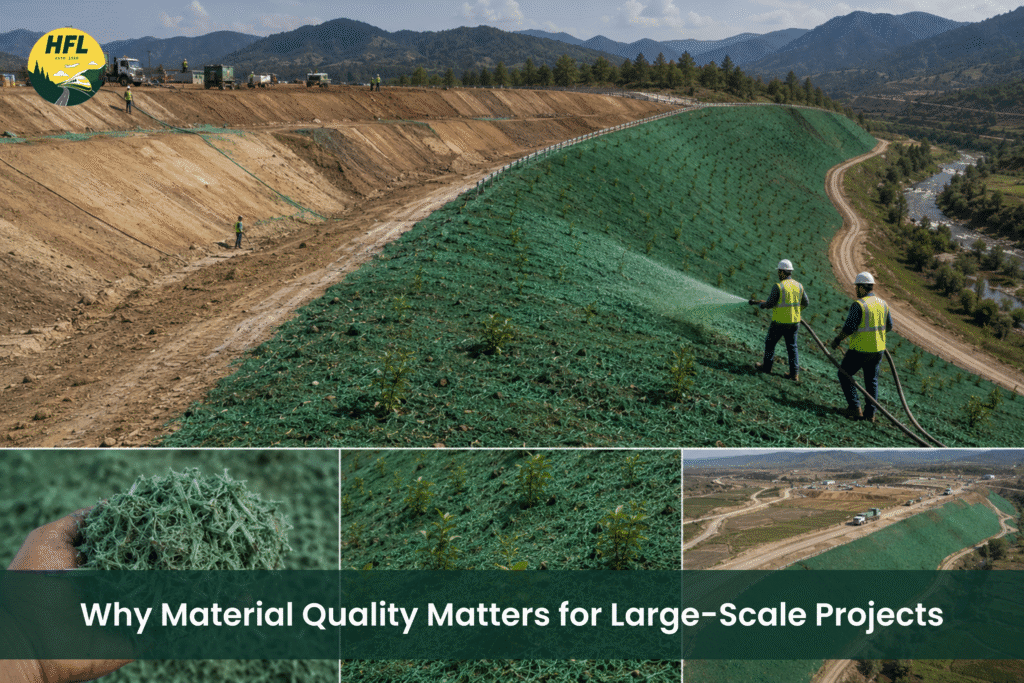
Why Material Quality Matters for Large-Scale Projects
The larger the project, the more important consistency becomes.
A small difference in application efficiency may appear insignificant on one small area but become substantial across many hectares.
Small Inefficiencies Multiply at Scale
Think of an application process that is a touch longer per tank load because of material handling.
Those extra minutes over hundreds of loads can add up to many hours of extra labour and equipment time.
The same logic applies to material quantity, freight and rework.
The management of large-scale projects requires thinking in multiples.
A little saved on each unit can add up to a lot, as can a little wasted.
Therefore, procurement should be based on project-specific calculations.
Why Work With Haryana Forests Ltd?
Project managers need more than a low price.
They need materials that align with technical requirements, reliable supply and project objectives.
Focus on Value, Suitability, and Project Requirements
Haryana Forests Ltd understands that mulch selection should be based on the complete application—not simply the initial purchase cost.
For hydroseeding, revegetation, landscaping and erosion-related projects, teams should evaluate material characteristics alongside:
- Site conditions
- Application equipment
- Project specifications
- Required quantities
- Logistics
- Performance expectations
The goal should always be to choose a solution that makes technical and commercial sense for the specific project.
A well-informed procurement decision can help reduce uncertainty, support efficient application and protect the project’s overall budget.
Frequently Asked Questions (FAQs)
Q: 1. Is cheap mulch always a bad choice?
No. Price alone does not determine suitability. Project managers should compare composition, application requirements, coverage, consistency, site conditions and total installed cost before choosing.
Q: 2. Can low-quality mulch increase project costs?
Potentially, yes. If material causes inefficient application, higher usage, rework or additional labour, the total project cost may exceed the initial savings.
Q: 3. How should I compare hydroseeding mulch prices?
Compare total installed cost rather than unit price alone. Include material quantity, freight, labour, equipment time, application requirements and potential maintenance or rework.
Q: 4. Does every hydroseeding project need the same mulch?
No. Product selection depends on factors such as soil, slope, climate, erosion risk, vegetation goals, equipment and project specifications.
Q: 5. Can mulch alone prevent erosion?
Not always. High-risk sites may require additional erosion-control measures based on slope, runoff, soil conditions and engineering requirements.
Q: 6. What should I ask a mulch supplier before ordering?
Ask about composition, recommended applications, application rates, equipment compatibility, technical documentation, storage, supply capacity and product consistency.
Q: 7. Why consider Haryana Forests Ltd for project requirements?
Haryana Forests Ltd focuses on helping customers evaluate mulch and related requirements according to project conditions, technical needs, application considerations and overall value.
Conclusion
Every project manager’s job is to save money on materials. But effective cost control is not the same as automatically selecting the lowest quotation.
The problem with cheap mulch versus quality mulch isn’t which product costs less on the purchase order – it’s which choice provides the required performance at the best overall project value.
Material quantity, coverage, labour, equipment efficiency, freight, reapplication, maintenance and schedule risk can all impact final cost.
A low-priced material may be perfectly suitable for a particular application when it meets the required specifications. Equally, paying more for a product does not automatically guarantee better project outcomes.
What matters is selecting the right material for the right site.
Project managers should evaluate technical documentation, application requirements, site conditions, supplier reliability, and total installed cost before making a procurement decision.
For large-scale hydroseeding, revegetation, landscaping, or erosion-control work, these decisions become even more important because small differences in efficiency can multiply across the entire project.
Haryana Forests Ltd promotes an approach of project based selection of materials based on suitability, consistency, technical requirements and long term value rather than price consideration alone.
Because the cheapest material is only truly cost-effective when it is doing the job it is meant to do.
When it doesn’t, the hidden costs can far outweigh the original saving.